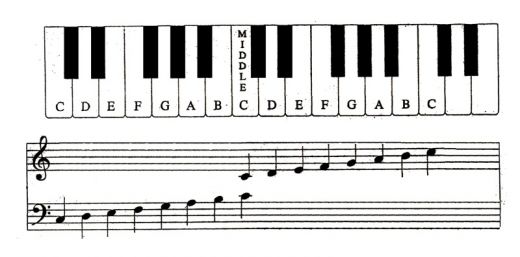
Music notation is written on a stave. The notes are named from A to G in ascending order. The music stave is series of five parallel lines. The first symbol you will find on a music stave is the clef. The pianist needs to learn how to read the treble clef and the bass clef. The notes are shown first in relation to their position on the keyboard. The first thing to note is that the notes revolve around middle C in the middle of the keyboard. Then go hunting for more patterns in music notation which will help you to decode the music quickly.
To begin with the right hand plays music written in the treble clef. The easiest way to memorise the notes is by learning that the notes on the lines of the treble clef correspond to the mnemonic: Every Good Boy Deserves Favour. The notes on the spaces of the treble clef spell: FACE

To begin with the left hand plays music written in the bass clef. The easiest way to memorise the notes is by learning that the notes on the lines of the bass clef correspond to the mnemonic: Good Boys Deserve Favour Always. The notes on the spaces of the bass clef create the mnemonic: All Cows Eat Grass.

Symmetry in Music Notation.There exists some interesting points of symmetry which will help the inexperienced pianist to read the music above, inbetween and below the treble and bass clefs. It concerns the way in which the pitches of notes revolve around the note C. The note C4 (known as middle C) is right in the middle of music notation: one ledger line below the treble clef, one ledger line above the bass clef. The notes C3 and C5 are respectively second space up and second space down. The notes C2 and C6 are respectively two ledger lines below the bass clef and two ledger lines above the treble clef. |
 |
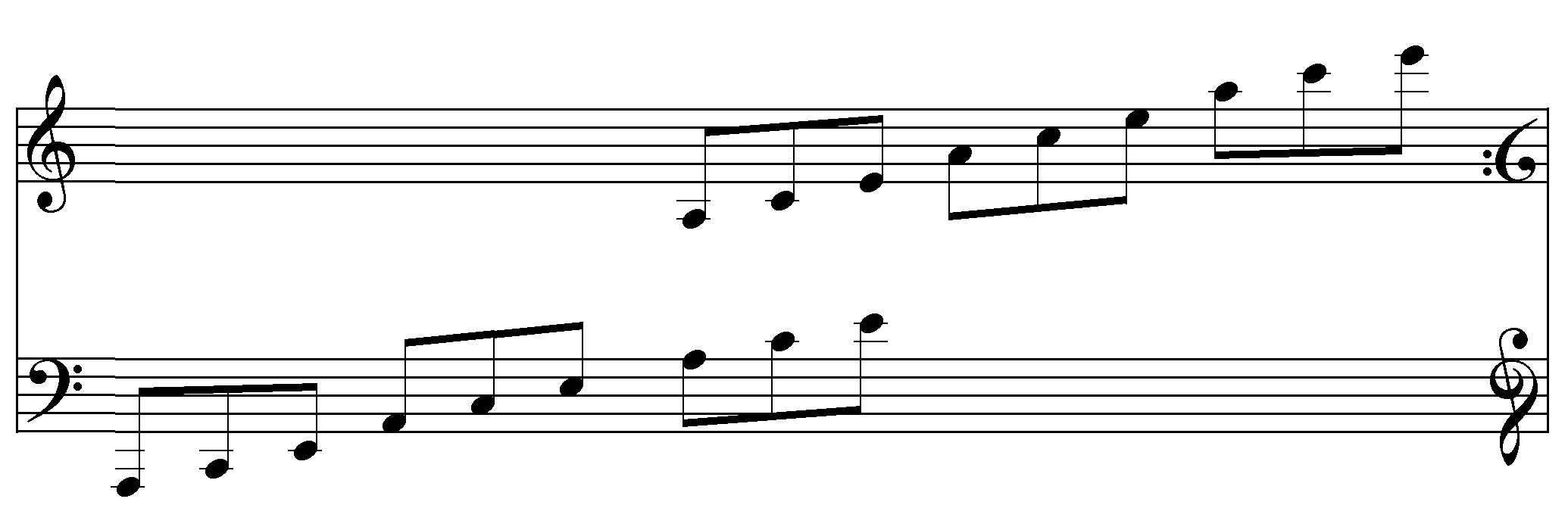
Symmetry in the Middle of the Treble and Bass Clef.It then becomes apparent that the notes A,C and E have a rotational symmetry, first in the centre of the treble and bass clef. The three notes spell ACE. |
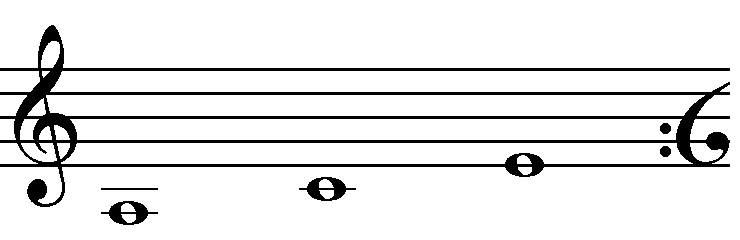 |
Symmetry Above and Below the Treble and Bass Clef.Then over and under the treble and bass clef. i.e. Above the treble clef the ledger lines spell ACE. Below the bass clef the ledger lines spell ACE. |
 |
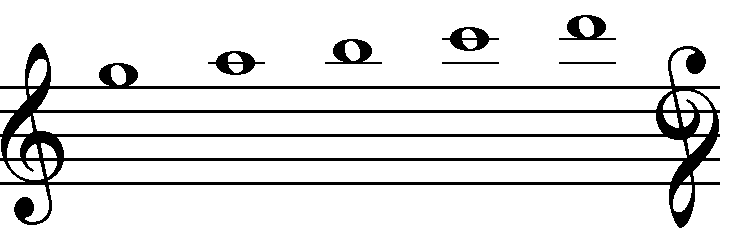
Symmetry Above and Below the Treble Clef.There exists symmetry above and below the treble clef. The notes used will be G,A,B,C and D. |
 |
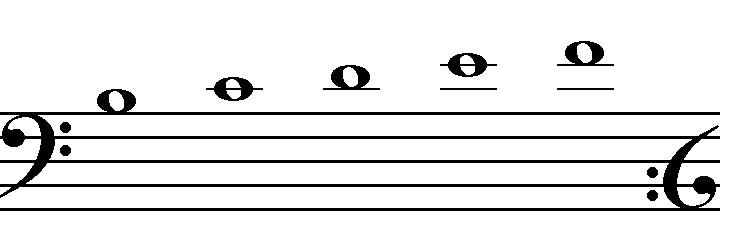
Symmetry Above and Below the Bass Clef.If symmetry is above and below the treble clef, it is also above and below the bass clef. The notes used will be B,C,D,E and F. |
 |
The arpeggio of A minor, with the notes A,C and E, shows the rotational symmetry of stave notation. It can be read upside down. But the final word on rotational symmetry in music belongs to a genius like Mozart. To consider how far this trick can be taken, consider the piece 'Der Spiegel' attributed to W. A. Mozart, which takes this matter to a completely different level.
To return to my homepage click here.
Copyright © 2021 Jonathan Jessop.